Thursday, February 28, 2013

Now, that just seems cruel

So, I am doing my best to learn French. I listen to podcasts, I read textbooks, I watch Firefly in French. I am in chapter 12 of Harry Potter. Hogwarts is called Poudlard. I regularly scour the internet for activities and games.

As useful as the online activities are for practice, they are often most memorable for their glimpses into cultural differences. A lot can be learned by what photos are selected to represent "fat" or "ugly" in a photo-matching game. Even more can be learned from the apparently necessary racial differences in photos of "lawyers" versus "thieves." And then today I saw this:


At first glance, this is clearly a page about maladies... more specifically bad things that can happen to your skin. There are pimples, warts, corns, contusions, cuts, and bruises. And then there is the the third photo in the top row of the rather smug looking redhead. There doesn't appear to be anything wrong with her. By process of elimination I determined what all of the other photos were, then I took the correct answer for the mystery photo and popped it into google translate.

So what is the mystery malady that belongs on a page with warts and flesh wounds?


Now, that just seems cruel. 

Sunday, January 27, 2013

CERN - The "C" is for "Organization"

The bartender says, "We don't serve neutrinos here."
A neutrino walks into a bar. 

I don't believe that most people who tour Cern get to experience the pure nerdliness that I had a chance to be a part of this week. Due to an error in emailing, the tour meant for EPFL physics and engineering students had some slots left and I was able to go. This did not change the fact, however, that the tour was designed for -and populated by - people with at least a basic understanding in particle physics. 

The trip started at the hilarious intersection of swiss planning and rule-abiding engineers. To accommodate for any potential late-comers, the trip organizers told us all to meet half-an-hour before the bus was meant to leave. With normal humans this would be a practical approach. When your entire population is rule-abiding, graduate and post-graduate engineers, it means that you have 35 people arriving 15 minutes before the deadline, a full 45 minutes before the bus is meant to leave. One of our friends had even skipped buying lunch to make the early deadline and stand in the cold without food just in case the bus might leave. He was eventually persuaded to go buy a sandwich. 

We left on schedule and made excellent time on the road to Geneva. This, of course, meant that the one-hour window of extra time that had been blocked into the schedule for late comers and traffic meant that we arrived an hour before our scheduled tour. And what do a group of engineers do with an hour to spare before a three-hour tour? Why they tour the exhibit hall, of course! 

In the basement of the welcome center, the exhibit hall is designed for the general public and school-aged children. Here Kris pulls on a lever to demonstrate how hard it is to separate the particles in the nucleus of an atom. Clearly it is difficult. Look at him straining. 


There were also exhibits demonstrating the effect of varying gravity on 12 kg weights and one of those lightening ball things you put your hands on. 

There there were exhibits whose intended audience was less clear. One enthusiastically told you to reproduce an experiment that went on to earn the nobel prize. It even used multiple exclamation points!! In reality you flipped a switch and turned two knobs until the graph on on the display made a horizontal line. Science! Another instructed you to take measurements and make a histogram of the results. Not to worry, kids. Graph paper and pencils are available at the welcome desk. 

One room was enticingly labelled "Mysteries of the Universe." It contained wall-mounted headsets with questions like "Why do particles have mass?" The questions were posed in English, French, Italian, or German and had mini lectures by experts from around the world. Note in the last sentence that I said "or" instead of "and." The mass of particles was introduced in English, but if you wanted to know whether the universe is symmetric, you better speak Italian. See Fabio, Kris, Rick, and Phil being riveted in the pictures below. 


The exhibit hall also contained a piece of the tubing used in the Large Hadron Collider, complete with a wall mural to make you  actually feel like you are down in the tunnel. 


It was a popular spot for group photos. And for people who enjoy awkwardly taking pictures of the backs of other people's group photos. 


Finally it was time for our tour, so we headed back up to the welcome center to meet our guide. We were briskly gathered and lead to an adjacent building, passing a yard of structures that could have been a truly epic playground equipment, but instead was some mildly interested outdoor art. 


We all filed into a swanky lecture hall and readied ourselves to be amazed. The guide introduced himself and explained that tours are usually preceded by a brief introduction to the facility, but as we were all obviously qualified we would skip the basics, do a quick summary of the current state of particle-physics research and then watch a 10-minute video. He then apologized that we were getting started late, as his talk was 50 minutes and was meant to finish with the video at the top of the hour. We were literally 2 minutes behind schedule. I know, because the wall clock was a Rolex. 


Our guide then began his talk, briefly laying out the history of this impressive facility. LIke most people of my age and nationality, I associate CERN with one thing: The Higgs Boson (better known as the God Particle). When I posted my excitement about visiting CERN (yes I did that) my cousin-in-law told me to say hello the the God Particle for her (yes, Alicia did that). And while this recent work is amazing step in particle physics research and our broader understanding of the universe, I found myself being impressed by something else. 

CERN (the European Organization for Nuclear Research) started back in 1954. 1954! That means that less than 10 years after the end of World War II the nations of Europe got together and created a nuclear research program that has persisted for more than half a century. 

"Feel free to take pictures!" our guide told us. "As we are a government-funded project, we have no secrets." This and my experiences with US-funded government research could not have been in greater conflict. 

Many of my experiences with scientific equipment in the US has been with University labs that could not afford to have the proper technician on staff, so microscopes, probes, and lasers were maintained by an ever-changing cycling set of graduate students or simply fall into disrepair. One of the detectors at CERN has more than 20,000 components. Experiments are run simultaneously by scientists from multiple countries and have goals on the scale of decades. When asked how much the swiss population pays in taxes for their share of this pan-european collaboration, our guide told us, "About 2.20 CHF per citizen per year. The equivalent of one nice cup of coffee."

While I was marveling at the ability for countries who had only a few years previously been at war to agree to an international tax to fund scientific research, when my own country's politicians earn votes by slashing funding science in their state, my guide moved on to the "review" of particle physics. 

I had not had a physics class since high school, so I was alternating between being deeply interested and completely snowed. In the end I came out with something like this:

We know that particles have mass. We know this because this mass causes particles to slow down from shooting around the universe at the speed of light enough to form stars and planets and trees and people. We also know that all of those stars and planets and trees and people, when you look at them close enough are made up of atoms ; which are made up of protons, neutrons, and electrons; which are made up of quarks and leptons. And this is great! By looking at the little pieces that make up the universe and looking at the way they interact we can fill in some of those "Mysteries of the Universe" from the room in the exhibit hall. 

It lets us ask questions like "Why do particles have mass?" We know that they do, because we are surrounded by stars and planets and trees and people. But, when we look at the tiny pieces that make us up, no matter how close we look we can't find anything that gives them mass. 

Likewise, when we look at galaxies spinning far away we find that they are spinning too fast for how much matter we can see. Imagine swinging a lead weight around on the end of a string. Eventually, if you swing it too fast the string will break. Well, for these galaxies the string should break. But it doesn't ... they just keep on spinning. It's a mystery. 

It's a mystery that we can get closer to understanding by smashing particles together at incredibly high speeds. And to do that, you need a particle accelerator and a huge damn tube lined with magnets. And at CERN, they have been doing that since 1954. 

From here the lecture started to focus on numbers. Like the 100 billion protons in each packet that is accelerated and then launched into the Large Hadron Collider. Or how 3,000 of these packets can be cycling at through the collider at any given time, crossing paths and colliding ~40 times per second in the 4 simultaneous detectors. These detectors, by the way, have tens of thousands of pieces and vary in size from your house to your office building. This part of the lecture also featured phrases like "quark gluon plasma," "cosmic microwave background radiation," and "as we all remember about the behavior of depleted uranium." 

After the lecture we watched a video that seemed to feature a rogue woman who had secretly entered the Large Hadron Collider tunnels with a bicycle and had decided to film herself describing the experiments video-ing herself on a helmet cam while peddling around a multi-million dollar international nuclear research facility. She also felt tribal drums and the Beatles were the appropriate soundtrack for such an endeavor. I'm not sure it is the video I would have made to explain my facility to the public. 

Finally it was time to tour the actual facilities. Because the Large Hadron Collider was running (with its millions of billions of particles flying around) we couldn't actually go down into the tunnels, but we would get to see one of the smaller accelerators and the computing center. Starting in March the Large Hadron Collider will be shut down for improvements (to allow for 7000 packets of protons) and I hope to go back and see one of the detectors. We broke into smaller groups and our set headed to the accelerator first. 

Our tour started with an explanation that due to the presence of radioactive materials, our guide was wearing a radiation-detection badge on behalf of all of us. If his detector read zero at the end of the day, we were all in the clear. If it didn't, we wold all be getting a phone call. In all of the years CERN has been giving tours, no one has gotten a phone call. 


We went into a building roughly the size of an airplane hangar and though we could hear the hum and click of active machinery, our tour started with a bunch of shelves. This wing had originally housed a detector, but with improvements since the 1960s, it became obsolete and eventually got broken down. 

"The blue shelves hold parts from the old instrument, scheduled to be repurposed for new experiments in coming years," our guide explained. "The green shelves hold all of the parts that have become mildly radioactive. We have to house them for a couple of decades before they can be scrapped." Simple enough.


Then we turned around and faced a row of windows that locked into a large lab filled with desks, computers, and a dozen or so graduate students. I had seen a similar setup before at the LRO lab in Arizona. One of the prices you pay for working on cutting-edge research is that tours get to ogle you through glass like you are part of a zoo. 

"See here, young scientists in their natural habitat. They work in packs to learn the skills to survive the academic wild. Very few of them will actually make it. Notice the extensive consumption of coffee and inappropriate wearing of pajama pants in a professional environment."

The lab was actually quite swank, with a quad-monitor setup at every station. 


Here is the output from one of the recent collision. 


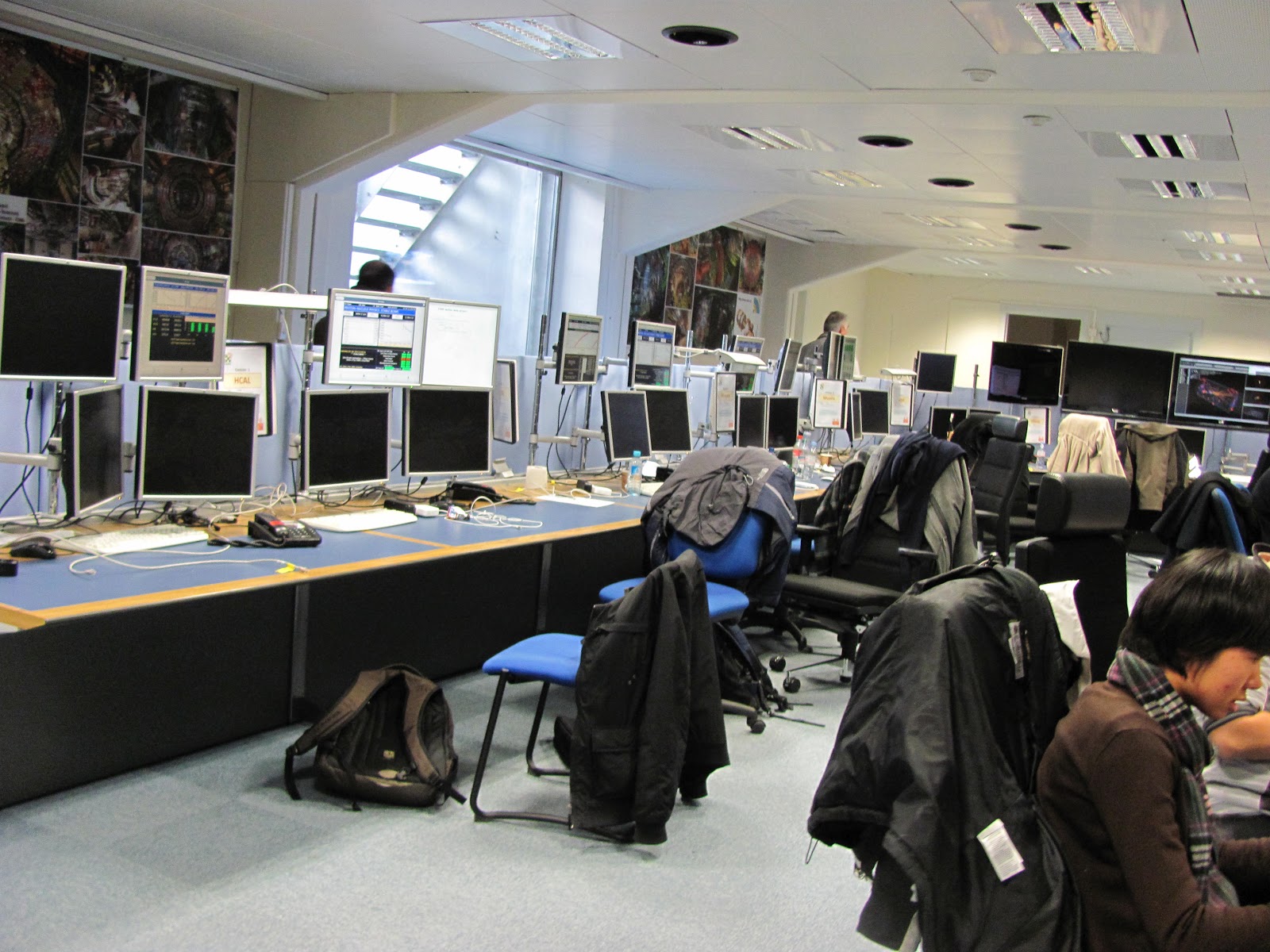
We then proceeded to a room of monitors with the real-time output from each of the detectors and accelerators and a large cartoon of the entire CERN setup. 


Our guide summarized the history of some of the more recent experiments, including the one last year in which an instrumentation error made it appear that neutrinos had travelled faster than the speed of light. This, of course, got a lot of media attention even though the scientists were still in the process of trying to reproduce the results. 

A check of the instruments and a rerun of the experiment showed that neutrinos, like everything else, do not travel faster than the speed of light. If they could, we would be facing all kinds of questions about relativity and whether effect could precede cause. Hence the joke at the top of the page: 

The bartender says, "We don't serve neutrinos here."
A neutrino walks into a bar. 

The fact that the results had been discounted did not make many headlines, and the ones it did make focused mainly on how speculation about how such a mistake could have been made. Even with precision instruments, shooting a bunch of neutrinos from Geneva through the mountains and measuring them as they pass a detector somewhere in central Italy is no trivial matter. There is a reason such experiments are run numerous times. 

We walked over to the other side of the building where the LEIR ( Low Energy Ion Ring) was running, accelerating particles to be sent off to one of the other instruments. The LEIR is maybe 1/3 third the size of a high-school track and uses a "race track" set up with accelerating straightaways paired with magnetized curves. A rhythmic clicking noise announced every time a flap opened to allow particles to pass from one vacuum to another. This instrument was used as part of a multi-stage process to get particles moving fast enough to collide with other particles or metal plates miles away. You can use the ladder bridge over the near side of the accelerator to give some scale. 


We peeked through a window at the proton synchrotron, which we could not approach while it was running. Next to the door was a huge slug of iron someone had apparently had a desperate need to set down. The cardboard they had opted for clearly could not hold the weight. While everyone else was peeking through the window, I was staring at this cardboard thinking, "well, clearly that didn't go as planned."


We did get to see a retired piece from one of the accelerators where alternating charges are used to pull particles through different chambers. See a brief explanation in French below. 


The arrival of another tour group signaled that it was our turn to head to the computing facility, which was a couple of buildings away. In France. The French-Swiss boarder runs through the middle of CERN, with small stone markers indicating where one country stops and another begins. See that dumpster? That dumpster is in Switzerland. 


See that white car? That car is in France!


A number of the buildings actually have strange slopes and notches to prevent them from being on both sides of the border. This is in case CERN is ever broken up and the land returned to the hosting countries.


The computing center, which houses over 200,000 pc's, is the building with all of the air conditioners sticking out of the top. If you have ever have a laptop get hot while sitting on your thighs, you can imagine the heat generated by 200,000 of them. 


Just outside of the building is this little sanctuary for computer mice. 


Inside, the facility looked something like this. 


And for any evil villain hoping to sabotage CERNs work, the sections are clearly labelled for "Mail Services" and "Network Backbone." 


Back in the 1960s, the computers were run using punch cards and the data was stored on giant disk that held only 10mb of data. (see the cd on the second shelf for scale). 


Now for all of you asking why we should go through all of this effort, those who think: Even if these experiments will let us answer some questions about the first moments of our universe, so what? Knowing a little bit more about why particles have mass has not real effect on you... here is why I disagree. 

In order to create experiments and facilities and instruments, scientists are constantly pushed to create new technology. When the magnets available weren't good enough, CERN made better ones. They are what we use for MRIs. When this team of international scientists needed a way to communicate about their experiments, one of them created the World Wide Web. You know that "www" at the start of the website? He created that. The first website was http://info.cern.ch


The first server was here, with a had-written note reminding others not to turn it off, because, you know, it was a server. 


And because it was created by an international government project, it wasn't patented. So instead of paying every time you use that "www" you just type and go. 

It may not seem like scientific research has any practical impact on your daily life, and it may seem appealing to disregard the scientists as selfish people who just want money for their pet projects. But remember, what we understand about genetics came from studying insects, the LEDs we use everyday were created to grow plants in space, and a particle accelerator gave us the World Wide Web. When scientists passionately push the boundaries of what is possible, everyone benefits. 

I have to say, it was a pretty good tour.  

Sunday, January 6, 2013

Science Fanboys and The Disney Family

A lot can be crammed into two-and-a-half weeks. We started with a three-hour on-board delay before an eight-hour flight, a sprint through customs, and landing in a snowstorm. Then there was the snowstorm. Then there were two family Christmases - one with an after-party at Starbucks - another snowstorm, a lunch with my cousins, and a six-hour drive to Pennsylvania. Then the 7th annual Winter Gathering of friends from Bucknell, the 5th annual Christmas puking disease (this year only Kris was affected), the Baker Family Christmas, the Carpenter Family New Year's, and a six-hour drive back to Ohio. Somewhere in there we had some magnificent visits, ate a lot of cookies, and slept just enough to be in the wrong time zone before coming back. Overall, as Kris and I drank our customary "Goodbye to Cleveland" beer at the Great Lakes Brewery at the airport, we were feeling pretty content.

Even though we were there with ample time (see earlier post concerning our vaguely obsessive punctual nature), Kris and I hurried to our gate to make sure we could both fill our water bottles and hit the bathroom before boarding. Kris headed off to the bathroom first and I sat with the bags, relieved that everything seemed to be going smoothly. As I waited a family of eight came and filled in the seats around me. The first thing I noticed was that they were all eating Subway sandwiches. The mom, the dad, the three grown daughters, two grown sons, and mildly obese uncle all sat down and started unwrapping their sandwiches in unison. It was surreal enough that I continued to stare, which gave me time to notice that every one of them was wearing some type of Disneyworld shirt. At this point, three of the family members seemed to find out that jalepeno peppers are hot and started waving their hands in front of their mouths and voicing alarm in rapid Quebecois (Canadian French). Two began removing the peppers; the daughter in front of me decided to tough it out. 

I was smiling when Kris returned and I did my best to fill him in using only mildly obvious whispers. I kept stealing glances at their matching shirts when one of the daughters caught my eye and I quickly looked down at her shoes. Which matched her sister's shoes. And her mother's. In fact, all of the women in the family were wearing matching sneakers and the men had their own darker version of the same pair. They were so new there wasn't even dirt on the bottoms. Three of the women were wearing the same watch. I pointed this out to Kris, and he added that all of the jeans were obviously new as well. It was as if the entire family had gone from Montreal to Disney naked or some tragic suitcase fire had led them to replace their wardrobes. Kris wanted to lean over and ask the mildly obese uncle if they had all just gone to Disney, but he decided against it. I kind of wish he had done it in the end. 

On the plane the Disney family was nowhere in sight, but three children under the age of four were in the rows next to, in front of, and behind us. Only the one next to us proved to be any problem. The wailing whine appeared to be her favorite means for conveying distress. Kris eventually fell asleep, but between the wailing child and the muddled time zones I wasn't getting any farther than trying to be still with my eyes closed. Eventually I got up to go to the bathroom. As I waited in the nook between the bathroom doors at the back of the plane, one of the flight attendants pulled up behind me with the drink cart. With some creative maneuvering we got him through. I smiled at him politely, acknowledging that I was waiting to use the bathroom in my socks, when he asked, "So, are you in the UN?"

I looked down at my socked feet and blue fleece and didn't feel that I particularly exuded "UN" but I just said no without trying to sound as confused as I felt. 

"Oh." he said, clearly surprised. He tilted his head and re-settled his hands on the drink cart. "Then why are you going to Geneva?"

"Because I live in Lausanne..." I responded. His look of confusion only deepened, so I continued. "We work at the Swiss Technical Institute."

"Oh," he said. "So you're a teacher." He looked relieved to have figured out who I was. 

"No," I continued. Things had not been going smoothly, so I tried to state things as clearly as I could. "My husband is a scientist and I work in publishing." 

"You're husband is a scientists!?!" he said, pushing the cart back towards me he was so excited. "I've never met a scientist before." 

"Well, there is one in row 28," I said. "He has red hair." 

At this the flight attendant smiled and backed away down the aisle with the drink cart. The bathrooms were still full, so I watched him go. When he got to row 28 he stopped, eyed Kris blandly watching  "Die Hard," smiled, gave me a thumbs up, and went on his way backing into the first class cabin clearly pleased. 

When I told Kris the story, he said, "Well, he still hasn't met a scientist... he just looked at one." I didn't really have a response for that.

After a few more hours, a train, two metros, and a walk we were back. And it's good to be home.  Happy New Year. 


Sunday, December 16, 2012

Things you never knew existed...

Warning: This post may not be safe for work or appropriate for children... sorry...

I have known from references in books and on television that there is a rather enthusiastic subculture around the world that loves model trains. They buy them. They build landscapes for them. The give up entire basements to construct little worlds for these trains to ride through. What is critical, however is that all of the details, from the fake trees to the miniscule lights must be to scale. That means that there is an entire market for scale items to populate these strange little worlds. 1/87th scale model school buildings. 1/87th scale cars. 1/87th scale barber shop poles and lounging sheep and shopping carts. For the model train enthusiast, creating a realistic model world is key.

This never struck me as anything more than a bit eccentric. Sure, it's strange, but probably no stranger than collecting baseball cards or collecting Civil War paraphernalia if you really think about it. To be honest, I never really gave the model train community much thought.

Until last week.

Last week I learned that these miniature worlds, so focused on maintaining a representative-if-tiny reality, include people. Unlike tractors and trees, people spend approximately 97% of their time doing unflattering things. If you froze reality in the square mile around where you currently sit and made a 1/87th scale model of what each person was doing in that moment, what would you get? Well, you would get at least one person hunched forward looking at a computer screen with their chin in their hand (you). A few people would be sleeping. A couple might be walking or eating. Someone would be in the shower. Some teenager would be alone in his bedroom with a magazine. At least four people would be checking their smart phones. Probably ten are picking their noses. And someone, somewhere, is having sex.

And that brings us back to the world of our model train enthusiasts. That brings us back to the people who design the scale models to satisfy these reality-obsessed hobbyists. That brings us to the shelf of scale figurines in the toy department of a store that I was standing in front of last week in Augsburg, Germany. That brings us to this.


As you can see form Kris's thumb, these models are tiny. As you can see by looking at them, these models are naked. This company, in its pursuit to miniaturize the world, has miniaturized a community of nudists. Some poor factory employee somewhere spends his day with a tiny paint brush of black paint putting pubic hair on these figurines because, somewhere, one of these model train enthusiasts has decided his train happens to be driving by a nude beach.

Yes, there are more mundane models, but even in these the faithfulness to reality is astounding. Take this family outing, with the dog watching the children play in the sand.


Or these bank robbers holding a hostage; it is clear that someone puts a lot of thought into the body language.


Even these wandering street animals aren't just sitting around. No, they are stretching, sniffing, and peeing on things.


The sports fan collection is being notably unruly.


Clearly the person who designed the city-scene collection spent some time in  New York. There is a flasher, an old woman hitting someone with a purse, a beggar, and a man urinating in public! No world is complete without public urination.


And then there is this. The lower set can satisfy any of general need for your scale naked people being scale naked in their scale world. But, for certain situations, situations which include two of your scale people being scale naked, well that requires the top package.


Obviously displaying the figures themselves would be too graphic, but the customer needs to know what he is buying. So the company is kind enough to display the piece of furniture (a desk) and a stick figure cartoon of the models themselves. Out of morbid curiosity we checked the website to find that the "Sexy Times" collection is so popular that there are nine different scenarios for the model train enthusiast to pick from, each featuring a different piece of furniture and provocative cartoon silhouette. What more could a model enthusiast need?

I imagine that I don't want to know.

I hope that knowing these models exist has somehow added to your day. If you cannot get these images out of your mind despite trying, I am sorry. Know that you are not alone. Perhaps deal with it by making a blog post and ensuring that the images are burned into the minds of your friends and family as well.

Saturday, December 1, 2012

The Economically Priced Christmas Tree

Today started as a 14-chimney morning.

It may sound cheesy, but every morning Kris and I check out our window for two things: whether we can see the mountains and how many chimneys have smoke coming out of them. The answers give us at least a small idea of what the day will be like. The answer to the first question, and the inspiration for the name of this blog, is typically no. This morning the early winter fog had lifted giving a beautiful view of France.


The second question focuses on the bottom half of our view and is a little more obvious: the more people using their fireplaces, the colder it is outside. Recently it has been about eight or nine. As I said before, today started as a 14-chimney day.

The brisk air and snowy mountains seemed a fitting start for a day with the goal of finding and decorating a Christmas tree. Having such a goal was oddly refreshing after weeks of goals like "get a key to our mailbox," "fix the bathroom door so that it closes," "find out how the leasing agency lost our 1800 francs," and "get a working fridge." After weeks of being ignored by the agency, finding the right person to talk to, and a flurry of contractors, we are finally able to shift our focus to other things. That meant today started with a trip to Ikea.

This trip to Ikea (hopefully our last) was to fill in all of the holes that we had discovered in our household since moving in. Some holes were small, like more plates and a shelf for the bathroom. Others were larger. Apparently, when buying a duvet for a new bed, the dimensions of the duvet exactly matching the dimensions of the mattress is not a convenience, it is a highly misleading coincidence. Perhaps, if one sleeps alone and never rolls from side-to-side more than once in a complete night of sleep, this arrangement can work. If, however, there are two people sharing the bed and one rolls around a lot, or likes to read for a while with her knees up, or systematically rolls to face his spouse and grabs the blanket then turns away and lets go at least a dozen times per night ... then this arrangement is non-ideal. We needed a bigger blanket.

Our list set and our goals clear we blasted through Ikea in record time. On our way out we stopped in their holiday shop, grabbed the ready-made pack of ornaments and looked for a tree. The trees were small, but nice enough, interestingly displaying hanging upside-down from the shop ceiling. After a few minutes of looking a friendly looking employee smiled her way to us and asked if she could help. We explained (with much stumbling and ample pointing) that we were looking for a tree.

"Oh!" she exclaimed, clearly happy to understand our question. She smiled brightly and said, "We don't have any trees."

Thinking we had misunderstood we asked again, pointing to the trees on display.

"No," she smiled again. "Out of stock. Anything else?"

We shook our heads and she smiled off. Mostly victorious we headed back home to drop off our things and run to the grocery store. Thankfully, the grocery store had Christmas trees for sale. Each box was clearly labeled:


For those of you who don't understand German, the phrase roughly translates as, "Basic: The Economically Priced Christmas Tree." Obviously assured that we were getting the best bargain for our money, Kris and I grabbed a tree and headed for the registers.

That is, we started to. Our triumphant exit was interrupted by a box of small, and rather hideous, tree ornaments. For any of you who know my husband, you know that he has moments of odd taste. His stuffed animals include a mandril, an octopus, and an opossum. The last he liked to keep under the bed to scare me when I went looking for lost socks. So, you can imagine his joy at finding small squirrels seemingly made from old pine needles, fake fur, and bad vibes. Some of them were deeply unsettling. One was missing an eye. Kris took a few minutes, picked out the "cutest" one, named it Henri, and took it home to live in our Christmas tree.

Here's how it all turned out.

The tree


and, of course, Henri.


Merry Christmas.


Monday, November 19, 2012

Getting Swissed

Imagine you are waiting to catch the metro. You are standing with a dozen or so other people at the empty platform. Everyone is milling around at the accepted distance, establishing their place but not standing so close to the edge as to be in danger. Then the train starts approaching. Immediately the person who had been standing next to you steps directly in front of you, and is now precariously close to the platform. This triggers the person who has been standing to the other side of you to take action, stepping up to the other person in front of you, ever so slightly closer to the edge. It does not matter that the train has yet to stop, and so the exact location of the doors is as of yet unknown. As soon as the train does stop the jostling focuses on the doors. Even if there are only three people vying for one door, the jockeying continues until the door opens. You let the two people who have been forcing themselves in front of you step onto the train, trying to be the more mature person. Just as you lift your foot to step on, two more people materialize and squeeze into the 3/4-of-a-person space that had been between you and the entrance. Just as the doors are about to close, you make it in. Welcome to Lausanne, you just got swissed.

Kris and I have even experimented, seeing how close we can stand to the door and still have someone get in before us. Frequently, even though we are standing next to each other as the train pulls up, we will end up with four people between us by the time we actually board. At first we thought that this was an oddly aggressive practice in a highly structured society, but we have since learned that it is because the entire swiss population suffers from a common disability: they are incapable of waiting in line.

As Americans, we wait in line all the time. In the cafeteria. At amusement parks. At restaurants. Waiting to come in from recess in elementary school. When we walk up and see two people waiting at a reception desk, we go stand behind them. If another person arrives, he or she stands behind you. Simple.

In Switzerland this situation almost never arrises. When you walk into a building - anything from the post office to a cell phone store - there is a ticket machine. Think of the numbered tickets you get at the deli counter. Instead of standing in line in the order you arrived, everyone takes a ticket and sits or wanders around until their number appears on the overhead screen.

It's a chicken-or-egg question whether this system exists because swiss people can't wait in line or swiss people can't wait in line because this system exists. What is clear is that if the ticket system is in place, it MUST be used.

When Kris and I went to register with the power company we walked into a room with no customers and five employees behind five desks. After consulting the labels above the desks, we walked up to the employee for people who had just moved. Before we can even introduce ourselves he waves both hands in front of his face and tells us that we must first take a ticket. Looking back at the entrance we notice a small electronic ticket machine. We also notice that there are no other customers. We look back at the man to make sure he is serious and go get a ticket from the machine. The man then greets us politely and asks us what we need. We start making our way through the French phrases we had rehearsed when we are once more cut off and told that we are at the wrong desk. We were supposed to go to desk four; he is clearly at desk three. We apologize and head over to desk four, but are immediately stopped by more frustrated hand-waving and emphatic pointing. You can't just walk up to the desk; you must first go get a new ticket. Please note that in the time it took for this exchange, no new customers have come in. We get another ticket, proceed to desk four, and register. Simple. So much better than standing in line.

This protocol may seem ridiculous, but the few places we have encountered without the ticket machines are havens of frustration and a constant sense of impending chaos. Our insurance office serves as an excellent example. The lobby is set up with a single desk and a line of four chairs against the left wall.

Each time we have entered there has been one customer at the desk and at least one person sitting in the chairs. Being from a line-literate country, we recognize that our place is to sit in the other chairs and wait until everyone else in the room has been served before we approach the desk. We sit down, smile at the people in the other chairs. They recognize that we know our place in the metaphorical line and smile back.

Then another person enters the lobby. This person, either willfully or not, does not notice the people sitting in the chairs. This person sees the customer at the desk and walks up behind them. This new person does not stand at comfortable line distance, but rather stands so close that if the person at the desk bent to tie a shoe, they would bump the new person with their behind.

The people sitting in the chairs now begin to experience the early stages of panic. Has the person not seen them? Does the new person not understand that the people in the chairs are waiting instead of simply sitting there to enjoy the fake ferns and strange hissing noise from the overhead speakers? The people in the chairs begin to shift to the edges of their seats, never getting up but clutching frantically at their purses and making intense eye contact with the new person's left ear. In the US, this is the point where someone would say, "Hey! There is a line here!" possibly followed by a gender-specific or body-part-themed expletive. In Lausanne the people in the chairs simply become increasingly agitated until the person at the desk completes their transaction. At this point the person in the first chair leaps up and hurls herself at the desk in front of the new arrival, never making eye contact. Now confronted with the solid evidence of a genuine person standing in front of them, the new person looks around and takes one of the vacant chairs. The process can then repeat itself.

Viewed in this context the free-for-all of boarding the metro seems to make more sense. It isn't that you weren't standing close enough; it's that where you are standing doesn't matter. The goal is to get on the train. If you get on the train, you win. It makes me wonder what would happen if someone put a ticket machine on the platform and had the numbers appear over certain cars as the train pulled in. Would this fix the problem, or would people peacefully move to the door of their indicated car and then proceed to force their way in front of the other people allotted to the same car? I would be interested to find out.

That's all for now. Au revoir.


Friday, November 16, 2012

A Evening of Sweat, Stepping on Strangers, and Portu-french-kor-english


There are many ways to spend a Friday night in Lausanne. You can meet friends at a wine bar. You can go dancing. You can have friends over who need to borrow your shower (true story). Or, you can go to a two-hour taewkondo seminar given by your master's master who is in from Portugal. Tonight Kris and I chose the last.

Not knowing what to expect we brought all of our gear along and arrived relatively early. We had been told that the three-day seminar was quite popular. Bruno was nice enough to save us spots even though we had been out of the country during the sign-up period. He greeted us at the door like old friends, shook Kris's hand and leaned in to give me a kiss on the cheek. I have tried to channel my inner European with this, and even felt proud when I kissed him back without my usual, "Oh God, I am so american" flinch. I flubbed the second kiss, feeling so proud of the first, and completely failed to meet him on the third. Thankfully he wasn't weird about it and simply stated, "In Switzerland, we do three."

The kissing thing had actually come up at taekwondo before, when one of the blue belts asked me how many kisses Americans do. He thought Kris and I were messing with him when we told him none. After we showed him the handshake and the one-armed, bro-hug, he looked sad and asked if all Americans hate each other.

After a warm welcome and changing into our uniforms we milled around on the mats with a few of the people we recognized. Sam, a green belt, started to tell us about the visiting instructor's reputation for working black belts into the ground during practice. Having spent the week recovering from a chest cold, this did little to settle my nerves. Soon we were all called to attention and started warm-ups.

It didn't take long for me to notice that, even though I am used to understanding very little of what is being said, I was understanding even less. At first I thought it was the visiting master's accent, but I soon realized it was because he was speaking Portuguese. Since he is from Portugal, I guess I should have expected that. Things seemed to be going well enough for the portuguese students he had brought with him, and the french-speaking locals were getting by with the bits of critical French being tossed in with the Korean commands. Bits of English even made and appearance. An average set of instructions went something like this:

Portuguese Portuguese Portuguese, ok? Portuguese, the Korean numbers 10 and 20, French, French, French. Korean numbers, change. Korean numbers, stop. Portuguese, Portuguese. French, French. Go faster.

It has given me a new perspective on the idea of a melting pot.

As Sam had warned, the visiting master took the dozen black belts to the far side of the gym to make a separate group. With the exception of a few truly baffling language exchanges, Kris and I fell into place rather well. I was paired with the other short, female black belt and we did some more in-depth stretches. Unfortunately for my new (portuguese) partner, this included a number of wall stretches holding up your partner's leg. As my CW Taekwondo family has learned, my frame is quite deceiving. Even though I am 8 inches shorter than Kris, we have the same length legs. This meant that my more normally proportioned and equally short new partner had a hilariously hard time holding up my leg above her head. Rather than helping her out, the portuguese master saw this as a great photo op and took about 15 pictures.

The actual drills were fantastic and, though my legs may disagree tomorrow, felt really good to do again. Despite our limited ability to communicate verbally, my new partner and I were enjoying ourselves and sympathizing with each other by the end. Though the practice was long, it hadn't been as demanding as Kris and I had expected. We have since decided that it is probably abnormal that we have been to practices where people puke and keep going, have their legs just give out completely, or need help lifting their arms to put on a coat at the end. It made us miss our CW family a little bit more.

After practice we started the partner stretches again, with the added bonuses of walking up and down the back of your partner's thighs and pounding on their arms, legs, and back with your open palms. As we were standing around waiting for others to finish I rubbed my partner's shoulders. She moaned appreciatively and spoke her clearest English of the night, looking me in the eye and saying, "I should pay you." When I laughed, her boyfriend came over and she proceeded to tell him in Portuguese that I give better back rubs than he does. I laughed and felt like some of the cultural barriers were starting to come down.

The moment I enter the locker room I am reminded how far I still have to come. In the US, there is a certain set of expectations that go with locker-room etiquette. Once you are done showering, you will dry yourself and get dressed. Maybe you will stand around in a towel for a while. If you are one of those weird older folks, you will stand around naked for at least 20 minutes, but you won't make lasting eye contact with anyone. Ladies, if they are changing bras, will do so quickly. If a conversation is happening when underwear is being changed, no comments or eye contact are made.

In my Swiss locker room, everyone is standing around topless. Apparently, once you have showered, it is standard to put on some highly fashionable panties, and then mill around for awhile. You can brush your hair, talk to people. You can even weigh yourself and then talk about weighing yourself, sometimes holding panties or a bra in your hand seemingly just for emphasis. Once a bra is put on, you have a good long while before any other clothes are even considered. It is not uncommon at this stage to do your makeup. Apparently the situation is relatively similar in the men's locker room. Kris says that forcing himself to have conversations in French with a bunch of men standing around in boxer briefs is one way of fitting in.

Once everyone was finally dressed, we said our goodbyes and everyone kissed each other again. There seems to be no requirement for the language of the speaker to match the language of the listener. In French, English, and (we presume that was what was being said) Portuguese, everyone said they looked forward to seeing us tomorrow. I can honestly say that I am quite looking forward to seeing them.

Bonne nuit.
Boa noite.
Good night.